

Conductive vs. Non-Conductive Copper Tape Adhesive
Choose conductive adhesive when your design needs an electrical path through the adhesive layer. Choose non-conductive adhesive when the tape mainly needs to hold copper foil in place and electrical contact through the glue is not required. Both versions have conductive copper foil. The difference is how the adhesive affects the connections underneath the foil and between overlapping strips.
That distinction matters when buying copper tape for EMI shielding, guitar cavities, paper circuits or decorative work. A copper-colored roll can look right for a project while having the wrong adhesive for its electrical connections.
What is the difference between the two adhesive types?
Conductive copper tape adhesive is formulated to provide electrical contact between the copper backing and a suitable conductive surface. For example, 3M describes conductive particles in its 1181 tape adhesive as the path between the backing and substrate. The resistance of an actual joint still depends on the tape, contact area, surface condition and application.
Non-conductive copper tape adhesive bonds the foil to a surface without providing that intended conductive path through the glue. Electricity can still travel along the exposed copper face. Do not assume it will travel through an adhesive-backed overlap or into the surface underneath.
Conductive vs. non-conductive adhesive: quick comparison
| Question | Conductive adhesive | Non-conductive adhesive |
|---|---|---|
| Does the copper foil conduct? | Yes | Yes |
| Is the adhesive intended to carry electrical contact? | Yes; verify the installed joint | No; provide a separate connection where needed |
| Can overlapping strips form a connected shield? | Useful when the layout relies on contact through the adhesive; check every seam | Do not rely on an ordinary adhesive-backed overlap for continuity |
| Where is it useful? | Suitable shielding seams, guitar cavity linings and connected low-voltage circuit layouts | Decorative borders, craft work and foil layouts with separately designed electrical connections |
| Is it electrical insulation? | No | No: the copper remains conductive |
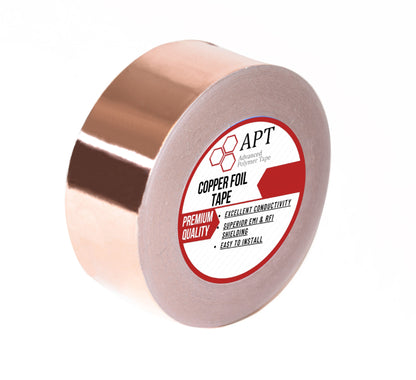
Copper Foil Tape with Conductive Adhesive
Choose this version when your design needs electrical contact through the adhesive. Available in eight widths on 108-foot rolls.
Shop Conductive Copper Tape
Copper Foil Tape with Non-Conductive Adhesive
Choose this separate product for decorative work or designs with separate electrical connections. Select a width on the product page.
Shop Non-Conductive Copper TapeWhich applications need conductive adhesive?
EMI shielding with overlapping strips
Conductive adhesive is a useful choice when an enclosure shield needs electrical contact across foil overlaps or to a conductive substrate. Plan the seams and grounding connections before applying the tape. A conductive adhesive label alone does not establish a shielding rating for the finished enclosure.
For a closer look at seam layout and verification, read our conductive copper tape and EMI shielding guide.
Guitar pickup and control cavities
Guitar cavity shielding often uses several strips to follow corners and recesses. Conductive adhesive helps when those overlapping pieces need to function as one connected lining. Check continuity across the lining and its intended circuit-ground connection before reassembly. Shielding does not resolve every source of guitar hum or noise.
Our guitar shielding guide explains coverage, seam checks and installation considerations.
Low-voltage paper circuits with joins
Conductive adhesive can simplify a paper-circuit layout that joins separate pieces of copper tape. Non-conductive adhesive tape can also carry current along a continuous copper strip, but its overlaps need a suitable electrical connection. Chibitronics recommends folding a continuous strip around corners rather than cutting it into disconnected sections.
When is non-conductive adhesive the practical choice?
Decorative borders and craft work
If the goal is a copper surface on a card, display or decorative object, electrical contact through the adhesive may serve no purpose. Non-conductive adhesive can meet that part of the design without paying for a conductive bond. Check adhesion and compatibility on a sample of the actual surface first.
Foil assemblies with separate electrical connections
Non-conductive adhesive does not automatically rule out shielding. Manufacturers such as 3M offer copper shielding tape with non-conductive adhesive. The design must account for the required connections independently, rather than expecting the adhesive to connect every overlap or ground the foil to a substrate.
Likewise, solderability is a separate property from adhesive conductivity. Confirm the exact tape's process compatibility before soldering; do not assume all copper tapes tolerate the same heat exposure.
Check the electrical path before choosing
- Identify the path: along one copper strip, across a seam, or through adhesive to a substrate?
- Choose the adhesive: use conductive adhesive where the design relies on that bond for contact.
- Check the exact tape: review the construction, adhesive, application conditions and supporting data.
- Verify the installed joint: on a disconnected, unpowered assembly, check the required paths with a suitable meter. A continuity beep is a screening check, not a measurement of EMI shielding performance or a current rating.
Choose an APT copper tape option
APT offers separate copper foil tape products for the two adhesive types. Choose copper foil tape with conductive adhesive when your design needs a conductive adhesive bond. The separate copper foil tape with non-conductive adhesive suits designs that do not rely on electrical contact through the glue. Both are offered in 108-foot rolls and eight widths from 1/4 inch to 6 inches. In the store's base USD pricing, each non-conductive roll is $1 less than the conductive roll of the same width.
For technical data, custom sizes or help matching the tape to your surface and electrical requirements, contact APT.
Common questions
Is non-conductive copper tape still conductive?
Its copper foil is conductive. “Non-conductive” describes the adhesive, not the metal backing.
Does conductive adhesive mean double-sided tape?
No. Adhesive conductivity and the number of adhesive-coated faces are separate features. Check the product construction.
Can non-conductive adhesive be used for guitar shielding?
A design can use it if the required foil sections and ground connection are joined by a suitable separate method. Do not count on the adhesive-backed overlaps alone.
Technical references
These references explain general tape construction and application principles. Their product-specific specifications and approvals do not apply to APT tape.