

Paper vs Polyester vs Polyimide Masking Dots: Which Should You Choose?
Paper, polyester and polyimide masking dots serve different masking needs. All three are pre-cut circular masks, but their backing, adhesive, thickness and listed temperature ratings differ. Choose a masking disc for the job it must do, rather than by color or appearance alone.
This guide compares the three materials in the APT masking dots collection. Use the comparison to narrow your options, then confirm the selected product against your surface, chemicals, temperature and exposure time.
Masking dots and masking discs: what is the difference?
In this collection, dots and discs describe the same circular die-cut format. The material name identifies the backing. A pre-cut circle can help when a drawing calls for the same protected area on multiple parts, while roll tape may better suit long edges or shapes cut to length.
Compare the listed constructions
| Property | Paper dots | Polyester dots | Polyimide dots |
|---|---|---|---|
| Backing | Smooth crepe paper | 2 mil polyester film | 1 mil polyimide film |
| Adhesive | Natural rubber/resin | 1.5 mil silicone | 1.5 mil silicone |
| Total thickness | 7.5 mil | 3.5 mil | 2.5 mil |
| Listed temperature rating | 325°F / 163°C | 400°F / 204°C | 500°F / 260°C |
| Applications to evaluate | Wet spray and low-temperature coating | Powder coating and e-coating | PCB conformal coating and high-temperature electronics masking |
These are the ratings listed for the individual APT dot products. They do not establish a common dwell-time limit, chemical compatibility or clean-removal guarantee for every process. Keep the specifications for the exact die cut separate from those of similarly named roll tapes.
When to evaluate paper masking dots
Paper dots are an option for wet spray painting and coating processes within their confirmed temperature limit. The crepe-paper construction is thicker than the two film products in this comparison, so consider how the mask sits against the protected boundary.
The APT paper product is named Solder Wave masking dots, but its listed description focuses on wet spray and low-temperature powder coating. For a soldering operation, confirm the intended process and exposure conditions with APT before specifying it. The paper product is not recommended for outdoor exposure.
When to evaluate polyester masking discs
Polyester dots are designed for powder coating and e-coating masking. Compare them when the process fits their listed rating and you need repeated circular masks. Check any cleaning, pretreatment, anodizing or plating exposure separately rather than treating heat resistance as evidence of chemical compatibility.
For a production line, also compare the ease of positioning and removal. A material that meets the temperature requirement still needs to stay within the drawing's masking boundary throughout the process.

Paper Masking Dots
Crepe-paper dots with rubber/resin adhesive; listed rating 325°F / 163°C.
Shop Paper Masking Dots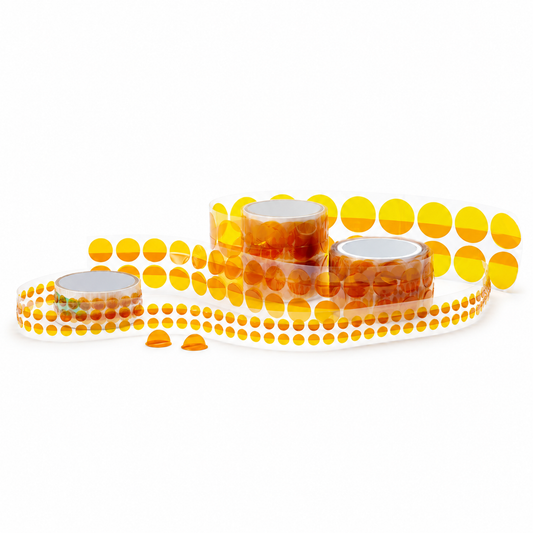
Polyimide Dots
Polyimide film with silicone adhesive; listed rating 500°F / 260°C.
Shop Polyimide Dots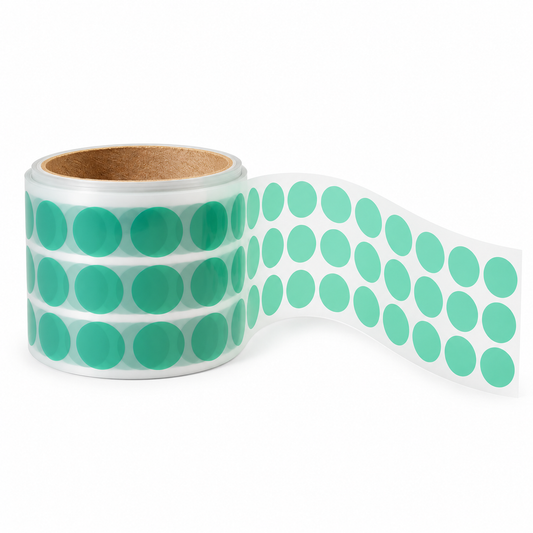
Polyester Masking Die Cuts
Polyester film with silicone adhesive; listed rating 400°F / 204°C.
Shop Polyester Masking Die CutsWhen to evaluate polyimide masking dots
Polyimide dots have the highest listed temperature rating of these three APT products. Their thin film backing is intended to conform to uneven surfaces. The product description lists electronics applications including PCB conformal coating masking and circuit board soldering.
A higher temperature rating does not automatically make polyimide the best choice for every coating job. Assess the adhesive, surface, exposure duration and removal result alongside the required temperature. Avoid paying for a different material solely because its headline rating is higher.
Choose a diameter, liner and quantity
Standard diameters span 1/8 inch to 2 inches across the three products. Choose the circle from the required protected area and tolerance, then validate its position on an actual part. Request a custom size if the standard diameters do not match the drawing.
Roll quantities vary by material as well as diameter. For example, the listed 1/2-inch paper option contains 5,000 discs per roll, while the 1/2-inch polyester and polyimide options contain 2,000. Compare the number of masks required for the job, not just the number of rolls.
Polyester and polyimide dots 3/8 inch or larger include a split-back liner. Smaller split liners are available on request; paper split-back liners are also available on request. Consider the operator's access to the part and how the liner will be peeled during positioning.
A practical selection checklist
- Identify the surface and the exact masking boundary.
- Record peak part temperature, time at temperature and repeat cycles.
- Include contact with cleaners, pretreatment chemicals or coatings.
- Check diameter, total thickness, liner format and masks per roll.
- Run a representative application, processing and removal trial.
- Inspect for coverage, edge lift, coating bleed and adhesive residue.
Common questions about masking dot materials
Are all masking dots suitable for powder coating?
No. Select the exact product for the complete coating cycle. APT polyester dots are designed for powder coating; paper dots are limited to compatible low-temperature processes, and polyimide dots require their own application checks.
Is polyimide the same as Kapton?
Kapton is a brand of polyimide film. These APT dots are described as commercial-grade polyimide; do not assume they use Kapton-branded film without confirmation.
Can I reuse a masking disc?
Do not assume reuse is suitable. A used disc may have coating buildup, reduced adhesion or a distorted edge. Confirm any reuse plan through the product supplier and your process validation.
Compare APT masking dots
Review the product options below or ask APT about a custom size. Provide your substrate, process temperature, exposure duration, drawing and quantity so the material and format can be evaluated together.
Paper Masking Dots
Crepe-paper dots with rubber/resin adhesive; listed rating 325°F / 163°C.
Shop Paper Masking DotsPolyimide Dots
Polyimide film with silicone adhesive; listed rating 500°F / 260°C.
Shop Polyimide DotsPolyester Masking Die Cuts
Polyester film with silicone adhesive; listed rating 400°F / 204°C.
Shop Polyester Masking Die Cuts