

What Is Aluminum Foil Tape Used For? Applications and Selection Tips
Aluminum foil tape is used for seaming and sealing insulation facings, HVAC-related applications, and appliance assembly. Its metal backing provides a conformable, reflective surface, while the adhesive bonds it to a compatible substrate. The right choice depends on the complete tape construction and the conditions at the joint.
This guide explains common aluminum tape uses and the specifications to check before ordering. Aluminum and aluminium are spelling variations for the same metal.
What is aluminum foil tape?
Aluminum foil tape combines a thin foil backing with pressure-sensitive adhesive. Some products have a removable release liner. The backing, adhesive and liner each serve a different purpose: the foil forms the exposed surface, the adhesive creates the bond, and the liner protects the adhesive before application.
Do not confuse foil backing thickness with total tape thickness. For example, APT Aluminum Tape has a 2 mil foil backing and 3.4 mil total thickness including adhesive. A mil is one thousandth of an inch. The paper liner is removed before installation.
Common aluminum tape applications
Seaming insulation facings
Foil tape can be considered for joining compatible insulation-facing surfaces where a continuous foil finish is needed. Check adhesion to the actual facing, the condition of the surface and the required sealing performance. A neat-looking overlap does not by itself demonstrate an airtight or waterproof assembly.
HVAC duct insulation and sealing
HVAC is a common use category for aluminum foil tapes, but products within that category have different qualifications. Select the closure material specified for the duct system. Where UL 181 or another approval is required, verify the exact product documentation rather than relying on a silver appearance or a temperature claim.
Refrigerator and freezer coil attachment
Aluminum foil tape is also used in appliance assembly to help hold coils or tubing in thermal contact with a compatible surface. Confirm the equipment maker's assembly requirements, operating temperatures and bond conditions. Tape selection alone does not establish the thermal performance of the completed appliance.
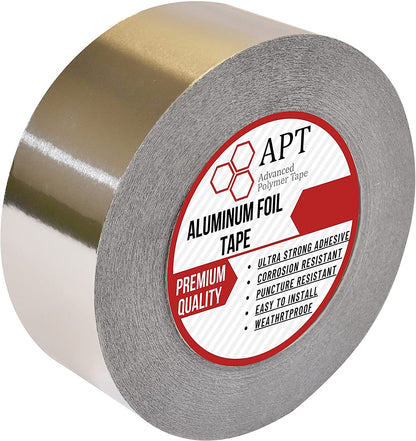
Aluminum Foil Tape
2 mil aluminum backing with acrylic adhesive. 3.4 mil total thickness. Available in 2-inch × 55-yard rolls.
Shop Aluminum TapeHow to choose aluminum foil adhesive tape
- Backing and total thickness: Compare both values. Include adhesive thickness when checking installed clearance or overlaps.
- Adhesive: Check compatibility with the metal, coating or insulation facing. An acrylic adhesive specification does not automatically establish electrical conductivity.
- Temperature: Consider the tape's exposure temperature and duration, and request application-temperature guidance where needed.
- Moisture and chemicals: Match the product to the actual exposure. Moisture resistance is not the same as a verified immersion or waterproof-seal rating.
- Width and length: Measure the seam and required overlap, then estimate material use across all joints.
- Approvals: Confirm any project-specific listing or test requirement for the exact tape.
APT aluminum tape specifications at a glance
| Property | Listed value |
|---|---|
| Backing | Dead-soft aluminum foil, 2 mil (0.0508 mm) |
| Total thickness | 3.4 mil including adhesive (approximately 0.0864 mm) |
| Adhesive | Acrylic |
| Liner | Easy-release paper |
| Listed temperature range | −65°F to 300°F (approximately −54°C to 149°C) |
| Roll size | 2 inches × 55 yards |
The listed temperature range does not provide separate continuous-use and short-term ratings. Contact APT with your exposure time and operating conditions if these distinctions affect selection.
Application checks before using foil tape
Prepare a small test area on the actual substrate. Remove loose contamination using a cleaning method compatible with the surface and tape, and let the surface dry. Apply manageable lengths without stretching the foil; press the bond area and overlaps firmly. Inspect for lifted edges, wrinkles and gaps before evaluating the assembly under representative conditions.
Use the equipment or insulation manufacturer's instructions for seam overlap, closure methods and inspection. Foil tape does not replace mechanical fastening or a specified structural repair.
Frequently asked questions
Is aluminum tape heat resistant?
Heat resistance depends on the complete tape, including its adhesive. APT Aluminum Tape lists −65°F to 300°F. Confirm the intended exposure rather than using the temperature tolerance of bare aluminum as the tape rating.
Is aluminum foil tape waterproof?
APT describes its aluminum tape as moisture resistant. Whether a finished joint provides a waterproof seal depends on application and exposure. Request product-specific guidance before immersion or use where leakage is unacceptable.
Can aluminum tape be used for electrical shielding?
Metal foil conductivity does not confirm conductivity through the adhesive or across seams. APT Aluminum Tape does not list a conductive-adhesive specification. Confirm the required electrical path before selecting a shielding tape.
Choose a roll for your application
Review the aluminum tape specifications and roll size, then compare them with your surface, seam dimensions and service conditions. For bulk quantities or custom-size inquiries, contact APT with your requirements.