Collection: EMI shielding Tape
Explore copper foil tape for EMI shielding projects where conductive material, adhesive contact, and seam design need to be evaluated together. Grounding, enclosure seams, and cable-shielding layouts require application-specific checks; a tape's material conductivity alone does not establish the shielding performance of a finished assembly.
Copper foil with conductive adhesive
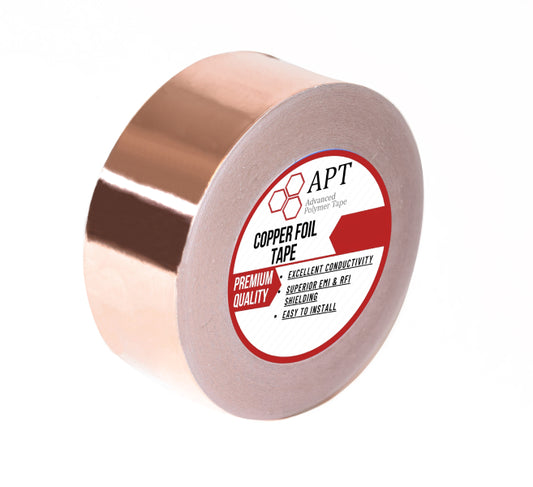
APT Copper Tape has a copper foil backing and conductive acrylic adhesive. The listed backing thickness is 1.4 mil and the total tape thickness is 2.8 mil. Review the product page for available roll widths and lengths.
When comparing conductive tapes, check both the backing and the adhesive. A conductive foil does not automatically mean that electrical contact through an adhesive layer meets the requirements of your design. Confirm the relevant resistance measurement, test method, and contact conditions for the exact tape.
For a closer look at foil and adhesive selection, read our conductive copper tape and EMI shielding guide.
Check the complete shielding design
- Identify the interference frequency range and the shielding result your design must achieve.
- Check the substrate, surface preparation, contact area, overlaps, seams, and intended grounding arrangement.
- Evaluate electrical continuity across the installed joints, including after the environmental exposure expected in service.
- Validate shielding effectiveness on the finished assembly using the test method required for your application.
No quantified shielding-effectiveness value in decibels or frequency-dependent performance curve is provided here. Do not treat the material description as certification of an enclosure or a guarantee of EMI compliance.
EMI shielding and static control are different requirements
If the goal is electrostatic-discharge control, see our anti-static application selection guidance. Conductive copper tape is not a substitute for verified ESD properties or a qualified static-control process.
Ask about copper tape for your application with your substrate, frequency range, seam or contact geometry, required dimensions, and applicable test requirements.