

Masking Dots for Powder Coating: Choosing Material, Diameter and Temperature Rating
Masking dots for powder coating protect circular areas that must remain uncoated. Also called masking discs or masking tape dots, these pre-cut shapes can replace hand-cut circles when the same feature appears across many parts. The right choice depends on the material, diameter and complete coating cycle.
Start with the drawing and process requirements, then compare the APT masking dots collection. A temperature rating alone does not tell you whether a mask will fit the feature or remove cleanly from your surface.
1. Match the material to the coating process
Polyester masking discs are a starting point to evaluate for powder coating. APT Polyester Masking Die Cuts use a 2 mil polyester backing and 1.5 mil silicone adhesive, for 3.5 mil total thickness. Their listed temperature rating is 400°F / 204°C.
For a process requiring a higher listed rating, compare Polyimide Dots. This product combines a 1 mil polyimide backing with 1.5 mil silicone adhesive, totaling 2.5 mil, and lists 500°F / 260°C. Confirm the exposure duration and adhesive performance for the actual cycle before selecting it.
Paper masking dots have a lower listed rating of 325°F / 163°C. The APT paper product lists wet spray and low-temperature powder coating applications. Use it only when the complete process fits the product's confirmed limits; do not substitute it into a hotter cure cycle based on shape alone.
2. Check part temperature and time at temperature
Record the peak temperature reached by the part, the time it spends at temperature and any repeated heating cycles. Include cleaning or pretreatment steps that occur after masking. Request current technical information for the exact product when a dwell-time limit or removal condition is not listed.
Keep roll tape and die-cut specifications separate. For example, the polyester dots list 204°C, while APT's separate polyester roll tape lists a maximum operating temperature of 200°C. Similar backing materials do not make the finished products interchangeable.
3. Choose the diameter from the masking boundary
Use the required uncoated area and its tolerance to choose a diameter. Check whether the mask must cover only a flat face or a larger boundary around a feature. A dot that is too small can leave an exposed ring; one that is too large can cover an area intended to receive coating.
APT standard masking-dot diameters run from 1/8 inch to 2 inches. Test placement on a representative part, especially where access is tight or the surface is curved. For an opening that needs protection inside the bore, confirm whether a surface disc meets the requirement or whether another masking format is needed.
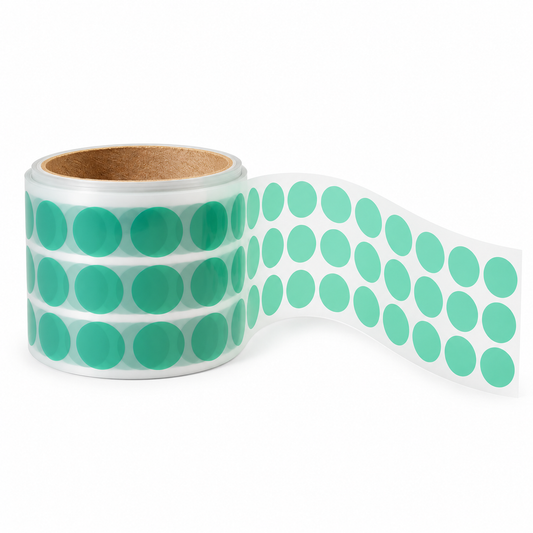
Polyester Masking Die Cuts
Polyester film with silicone adhesive; listed rating 400°F / 204°C.
Shop Polyester Masking Die Cuts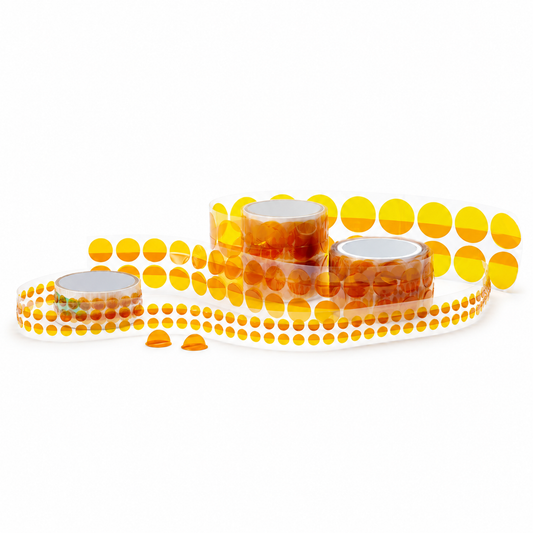
Polyimide Dots
Polyimide film with silicone adhesive; listed rating 500°F / 260°C.
Shop Polyimide Dots4. Plan liner handling and roll quantities
A split-back liner lets the operator separate the backing in sections while positioning the mask. APT polyester and polyimide dots 3/8 inch or larger include this liner; smaller split liners are available on request. Consider how operators will pick, position and remove the dots during repeated work.
Count protected features per part before ordering. For the listed polyester and polyimide dots, quantities range from 2,000 discs per roll at the smaller diameters to 250 at 2 inches. Check the selected option rather than assuming every size contains the same number.
5. Validate the complete application and removal cycle
- Prepare a clean, dry surface using a method compatible with the substrate and coating process.
- Place the dot within the drawing's masking boundary and press it down evenly, including the edge.
- Run the representative part through the actual pretreatment, coating, heating and cooling steps.
- Remove the mask under the product supplier's recommended conditions.
- Inspect for edge lift, coating bleed, incorrect coverage and adhesive residue.
Record the material, diameter, batch and process conditions once the trial meets your requirements. Repeat the evaluation when the coating, surface or heating cycle changes.
Masking dots for powder coating: common questions
Can I use paper dots instead of polyester dots?
Only if the paper product is suitable for the full process. APT paper dots have a lower listed temperature rating, so check the part temperature and exposure duration before substituting materials.
Will masking dots leave residue?
These products are intended for clean removal, but results depend on the surface, exposure time, temperature and removal conditions. Validate removal on a representative part.
Can I order a custom diameter?
Custom sizes are available on request. Contact APT with the required diameter or drawing, quantity, substrate and coating cycle.
Choose masking discs for your next production run
Compare the listed constructions and sizes below, or browse all masking dots and discs. For continuous edges, see our polyester roll tape.
Polyester Masking Die Cuts
Polyester film with silicone adhesive; listed rating 400°F / 204°C.
Shop Polyester Masking Die CutsPolyimide Dots
Polyimide film with silicone adhesive; listed rating 500°F / 260°C.
Shop Polyimide Dots